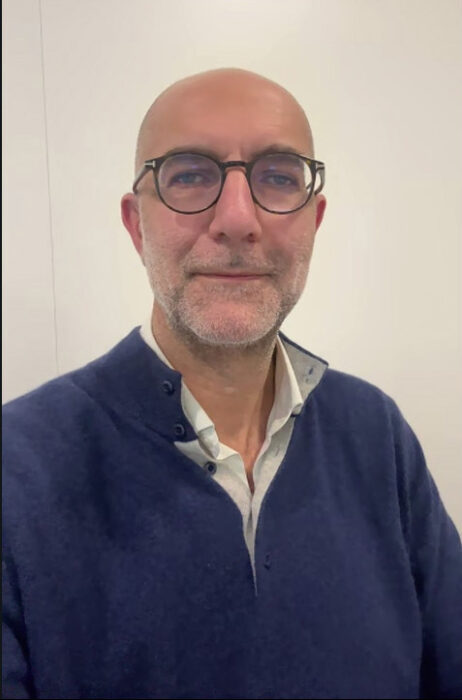
“Letters like these make my day,” says Abeye Co-Founder and CEO Michael Kodochian.
He’s describing some of the responses he’s received from users of Lexilens, the patented smart glasses he invented to help users with dyslexia read more smoothly.
In one case, a grandmother wrote to him, to say that her dyslexic granddaughter’s difficulties had previously led her to abandon her dream of becoming a nurse. But now, Lexilens was allowing the young woman to resume her studies.
And for Michael, results like this are the reason behind his work.
“I want somehow to contribute to a better world,” he says.
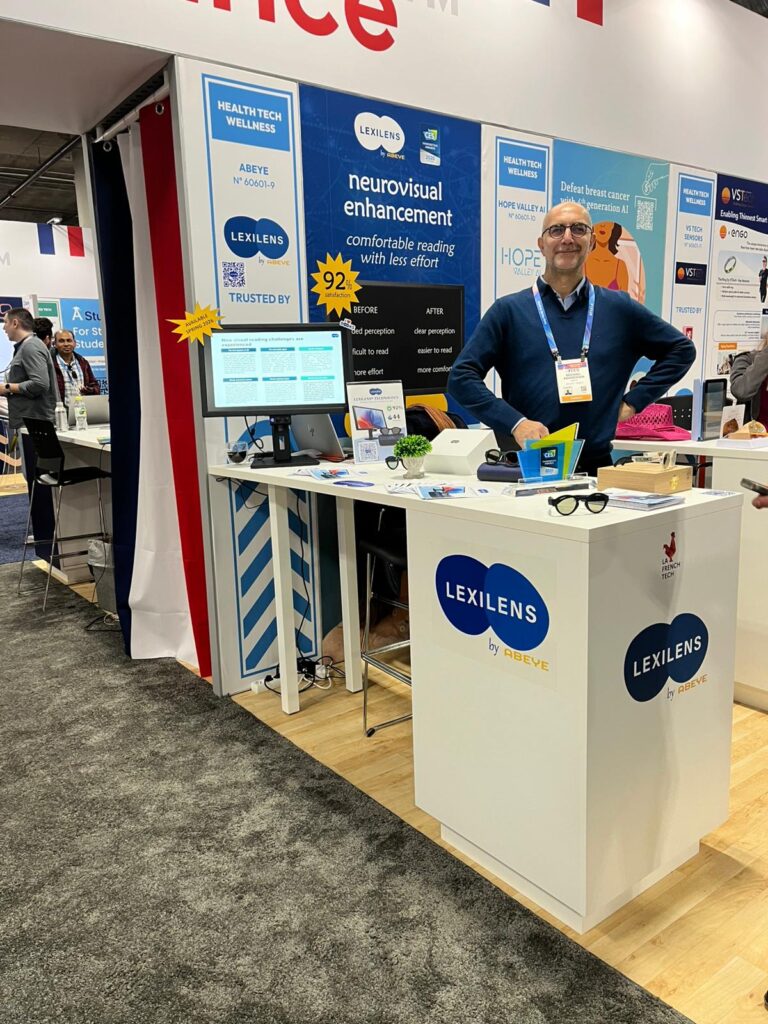
The workings of innovation
So, how does Lexilens work? In effect, it’s a neurovisual-enhancement filter.
“Lexilens corrects…the visual processing in the brain,” Michael explains.
“…It cleans the input (of information you’re reading).”
And the clarity it provides allows dyslexics to build their “dictionaries” of reading comprehension, due to being able to process the words on the printed page–or computer monitor–more easily.
Michael points out that these smart glasses do not distinguish letters, nor increase reading speed.
“It’s not magic,” he says, explaining that reading ability is built over time and that the person using it, not the device itself, will distinguish words.
However, it IS revolutionary.
What Lexilens does, is remove the visual “noise” of dyslexia, so that a user can develop these skills.
And there’s more…
While Lexilens, which has garnered numerous awards including a 2020 CES® Innovation Award, is currently available for sale, Michael and his team also have a new innovation: a smart monitor screen, which should be available in the U.S. in March!
Michael shared the story of his smart-eyewear startup Abeye and Lexilens, explained how the smart glasses work, and offered a closer look at some of the ways his technology is creating a better future.
On this edition of Over Coffee® we cover:
- How Michael first became inspired to use his talents, as an engineer and entrepreneur, to build smart eyewear;
- The early days of his startup, Abeye (and the story behind the name!);
- The story of Lexilens (which began with a research finding which, as Michael says, went “almost unnoticed”!);
- A turning point that showed Michael and his team the value of their innovation;
- What he’s observed, that people don’t necessarily know about dyslexia;
- A “demo” of Lexilens, and how it works;
- Abeye’s new innovation, the Lexilens Smart Screen, which will be available for computer monitors this spring!;
- MIchael’s vision for the future of Lexilens;
- Some of the feedback he’s received, on the ways his innovation is changing the future, for the better.