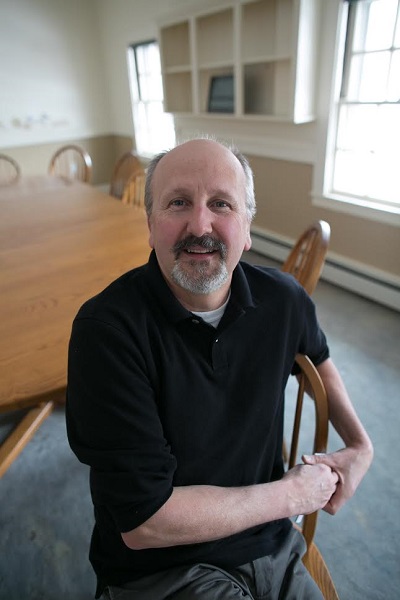
Design, digital fabrication and entrepreneurship are all part of Rich Lehrer’s daily work in education.
So is seeing extreme student engagement, as an exciting idea grows and flourishes.
Rich, who is now the Director of Academic Innovation and Design at the Alexander Dawson School at Rainbow Mountain, first came up with his “Problem Bank” concept while teaching science at Brookwood School in Manchester, Massachusetts.
We first spoke with Rich in 2017, after his new program had started off as the “3D Design Problem Bank“.
3D printing for a better world
How the concept worked: community members submitted problems to the school, for which they believed 3D printed devices could be a solution.
Then, Rich led his students through the collaborative process of becoming “Changemakers”, by designing and 3D printing devices to fill these needs.
Adaptive devices for senior citizens, prosthetics and classroom aids were among the items the students designed and developed, in close collaboration with the “clients” who gave them feedback.
An idea’s new manifestations
Today, the Problem Bank has grown far beyond these beginnings.
Currently, Dawson School’s middle-school STEM curricula include four courses based on client-based learning. Among these is the cornerstone class, the Dawson Design Company, which is run like a small business.
In addition to 3D printing, Dawson students are now using laser cutters and vinyl cutters to create items which solve problems. These creations can include websites, graphic design, media, signage, and much more. And in the design process, they never lose sight of the purpose: meeting client needs.
Besides entrepreneurship, the program places a strong emphasis on philanthropy and service.
Dawson Design Company students select one cause or organization, each semester. Then, they donate 100% of the proceeds from the products they make, to that group.
So far, Rich says, the Dawson Design Company has donated more than $11,000 to community organizations, including The Tyler Robinson Foundation.
And this Spring, some of Rich’s students won the inaugural ATLIS Visionary Excellence Award, for their work with the Dawson Design Company!
Rich talked about his journey with the Problem Bank, explained ways fellow educators can set up a Problem Bank program in their schools (which he highly encourages!), and offered a preview of what’s next.
On this edition of Over Coffee® we cover:
- How Rich went from being a middle-school science teacher, to guiding students in hands-on, real-world engineering and problem solving;
- A definition of the Problem Bank, and how Rich started it while teaching at Brookwood School in Massachusetts;
- A closer look at the ways design work has evolved, for the Dawson Design Company;
- The eight students who won the ATLIS Award;
- Why the client-based learning element is especially impactful for the students;
- One of Rich’s favorite stories, about a student who made him especially proud by creating an authentic design solution for a real-world problem;
- How this particular device worked!;
- Why this device’s use is symbolic of the work involved in any creative process;
- A closer look at three additional classes, “Spread the Word”, “Made By You”, and “Wear It,” included in the curricula;
- Where to see the students’ creations, and how you can support them;
- Rich’s advice to educators who would like to implement a “Problem Bank” while working in a traditional school setting;
- How to keep going, with the innovation, if something goes wrong;
- The community exercise with which Rich starts each of his classes, to focus students on the “why” behind their work;
- How Rich and his students have begun implementing the use of AI in their work;
- A new technique which Rich enjoyed learning and sharing with his students;
- Some of the new activities to which Rich is looking forward, in expanding his students’ work and sharing the idea of client-based learning with other educators.